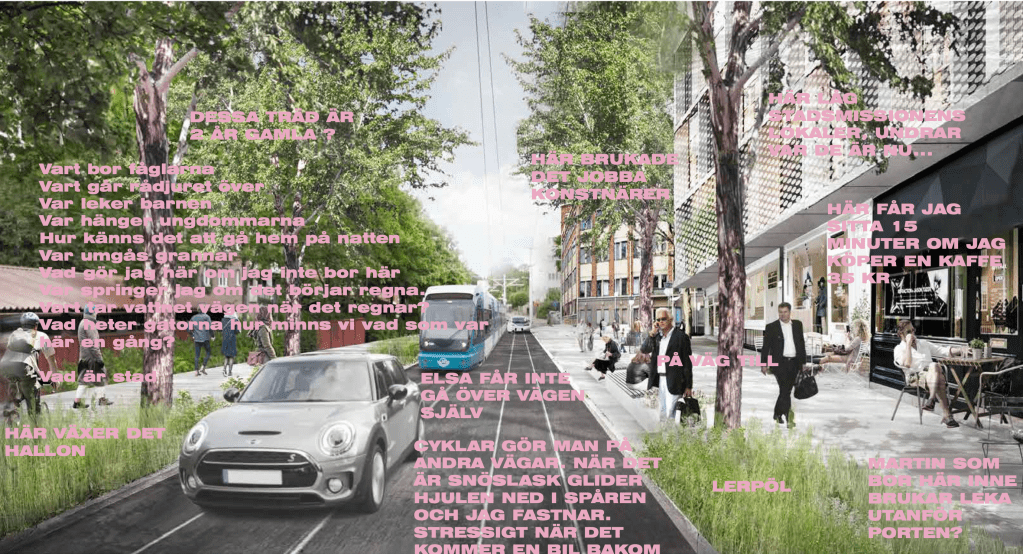
Acknowledging the importance of accessible information in a democracy – Discussing the difficulty to interact with visions of future city and the dangers of their seeming neutrality. Complementing constructed visions with images and words to add perspectives as basis for this discussion.
During the process of developing areas of our cities, images are usually constructed. In this initiative images produced in relation to evolving urban areas and public spaces were the focus. These images are meant to be indications of possible futures. Other documents actually legally frame what will become. However, usually the images are the material from which most people trying to understand the development seek information. Is there a danger here? Do we need a little cautionary sign next to every one of these images?
A curiosity about dissecting the visions for future city started when looking at the material produced in relation to the development of a detail plan for Lövholmen, Stockholm, in the company of colleagues from other fields of expertise that are not accustomed to processing information from material architects and urban planners rely on to communicate. The vision used as an example above contains different levels of indications. A caption accompanying the image where I find it in the material presented by the City Planning Department in Stockholm states clearly that the facades of the buildings in the image are indicative, but in this phase of the process there is more that can come to look very different.
The idea was to create material to have discussions about these issues around, and simultaneously encourage questioning what norms these images seem to reproduce without reflection – insisting that there are realistic, possible, alternatives. I found that putting other suggestions next to the images’ propositions made it very clear, focusing on one layer of meaning of the picture at a time, what it was actually suggesting, manifesting, reproducing. These suggestions regarded for example what was private or public, who the assumed subject/actor/inhabitant was, what actions were possible (or felt possible) – what behaviour expected – what or who was not visible in the image, how it would be experienced by various subjects. The added visual props also helped to shed light upon the difference between the layers of the image that were intentions, possibilities, and (unconscious) hopes – and what follow-up questions these vague suggestions warranted.
Det är svårt att interagera med eller ifrågasätta framtiden denna bild målar.
På en gång är den både jobbig, begränsande och ber mig göra något.
Den är också luddig. Men inte neutral?
Den innehåller värderingar. Subjekt.
Händelser, förutbestämda. Antagna.
Den utesluter, utan att jag ska tänka på det.
Vilken betydelse har det som inkluderas i bilden?
Vilken betydelse har det som exkluderas?
Vad saknas? Vad är sant? Vad är lögn, bestämt, outtalat, implicerat?
Nivåer av indikationer.
Ett luftslott går inte att kritisera förrän det är för sent.
När kan vi ställa krav?
Vem kan ställa krav?
Vem kan syna, säga? Vem har tiden?
Vad kan vi lita på?
Mänsklig skala, god kvalitet, publika rum, offentligt, privat?
Vad får jag göra här? Vad skulle jag önska att jag kunde göra här?
Vem går här, vem inte? Var är de på väg?
Var får jag vila? Vad förväntas av mig?
Kan man stanna upp någonstans, vila fötterna – betala?
Hur känns det? Varför då?
Känner jag mig trygg? Vilken tid på dygnet?
Vad händer inte? Hur länge?
Jag bara undrar för att kunna reagera.
 JENNY ÖVERGAARD